.png)
Types of Loft Conversion: A Homeowner’s Guide for Bournemouth & Dorset (2026)
Updated: Apr 14
What if the most valuable square footage in your Bournemouth home is currently gathering dust behind a hatch you haven't opened in years? Many Dorset homeowners feel their living space is shrinking but hesitate to act because they fear a bulky extension might ruin their property's kerb appeal. It's a valid concern, particularly when facing the meticulous planning standards set by BCP Council for 2026. Understanding the different types of loft conversion is the first step toward unlocking your home's hidden potential without compromising its structural character.
We believe that every renovation should be a seamless addition to your lifestyle and your architecture. This guide is designed to provide you with the professional reassurance needed to choose a bespoke solution that adds genuine value. You'll learn how to navigate the technical requirements of various builds, from simple rooflight designs to complex mansard extensions. We will preview the structural possibilities that maximise your floor space while maintaining the quiet excellence of your original home.
Key Takeaways
Learn how to perform the essential "Headroom Test" to ensure your Dorset roof space meets the 2.2-metre height requirement mandated by local building regulations.
Compare the four primary types of loft conversion to determine which structural style best balances your need for additional floor space with your home's external character.
Discover bespoke architectural solutions tailored for the region's unique property stock, including specialised designs for Christchurch bungalows and Bournemouth’s terraced housing.
Navigate the complexities of Permitted Development rights and identify when conservation area status or Article 4 directions in Poole and Bournemouth require formal planning permission.
Understand the value of a turnkey service that pairs traditional Dorset craftsmanship with meticulous project management to deliver a seamless, stress-free home transformation.
Table of Contents Is Your Dorset Home Suitable for a Loft Conversion? Comparing the 4 Primary Types of Loft Conversion Specialised Solutions: Bungalows and L-Shaped Conversions Planning Permission and Building Regs in Bournemouth & Poole Choosing Your Ideal Conversion with Rooster Construction
Is Your Dorset Home Suitable for a Loft Conversion?
A loft conversion is a bespoke structural modification that transforms an underutilised attic into a premium habitable space. It is a sophisticated engineering process that requires more than just laying floorboards; it involves a complete rethink of your home's load-bearing capabilities. Before exploring the specific types of loft conversion available, we must first determine if your property possesses the necessary physical attributes to support a high-end refurbishment.
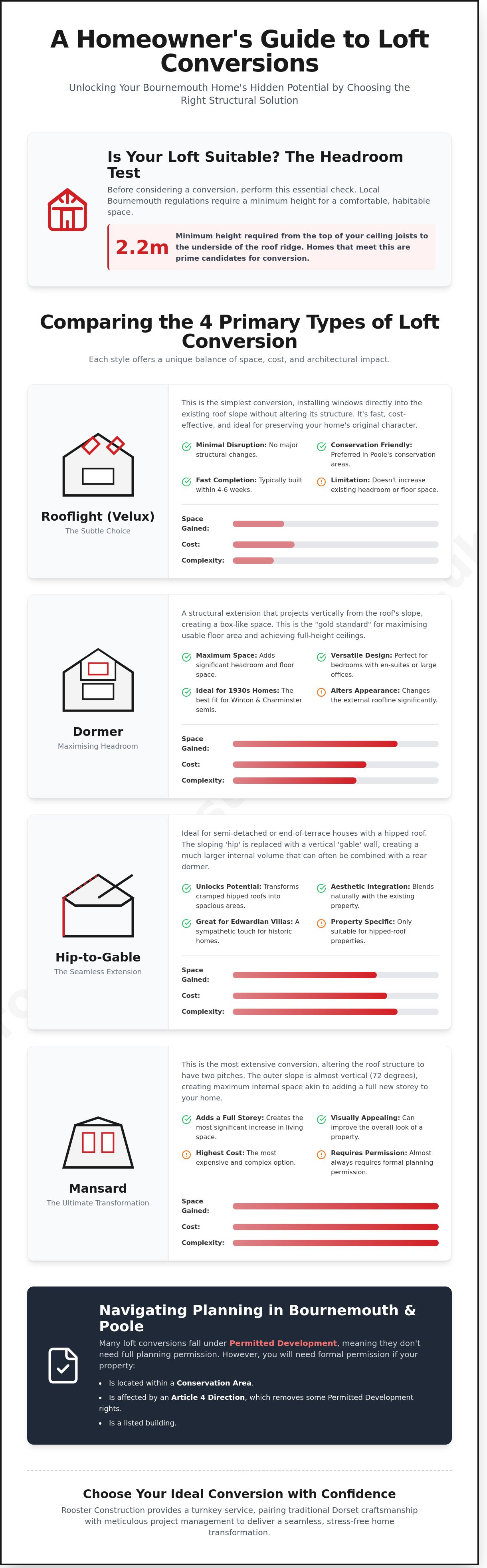
The feasibility of your project depends on three primary factors: the internal headroom, the roof pitch, and the internal span. In Bournemouth, building regulations are stringent regarding safety and habitability. We look for a minimum height of 2.2 metres at the highest point. If your loft meets this criterion, it likely provides a solid foundation for a seamless transition from a dusty storage area to a light-filled master suite or home office.
The 2.2m Rule and Structural Integrity
The "Headroom Test" is the first step in our meticulous assessment process. To measure this correctly, you should run a tape measure from the top of the existing ceiling joists to the underside of the ridge timber at the highest point of the roof. If this distance is 2.2 metres or more, your home is a prime candidate for a standard conversion. This height ensures that once the new floor joists and insulation are installed, the remaining headspace remains comfortable for daily use.
If your roof is lower than 2.2 metres, you still have options, though they require a more intensive approach. We often implement a "roof lift," which involves physically raising the ridge line to create the necessary clearance. While this is a more complex undertaking, it remains a viable way to unlock value in properties with shallow pitches. At Rooster Construction, structural integrity is our non-negotiable foundation; we never compromise on the stability of your home for the sake of aesthetics.
Matching Conversions to Bournemouth Architecture
Bournemouth boasts a rich architectural heritage that dictates which types of loft conversion will work best for your specific street. In residential hubs like Winton and Charminster, the 1930s semi-detached home is the dominant style. These properties are ideally suited for Dormer conversions, which we consider the gold standard for these builds because they maximise floor space and provide full-height ceilings.
The landscape changes when we move toward the Talbot Village area. Here, the Edwardian villas require a more sympathetic touch to preserve their historical character. We often recommend Velux or Hip-to-Gable solutions that integrate seamlessly with the existing roofline. For those living in traditional Dorset cottages, the challenge lies in working with older timber frames. We focus on preserving the original charm of these buildings while using modern project management efficiency to ensure the new structure is both beautiful and durable. Our goal is always to create a space that feels like a natural extension of the original house rather than an afterthought.
Comparing the 4 Primary Types of Loft Conversion
Every home in Bournemouth presents a unique structural puzzle. Choosing between the different types of loft conversion requires a balance of architectural ambition and practical necessity. You need to consider how the new structure interacts with your existing roofline while ensuring the interior delivers the square footage you require. The right choice depends on your property's original shape, your budget, and how much you intend to change the external appearance of your home.
Rooflight (Velux) Conversions: The Subtle Choice
This is the most straightforward approach to attic expansion. It involves installing high-quality windows into the existing slope of your roof without altering its shape or height. It's an excellent solution for homeowners who want to maintain the original silhouette of their property. Many projects in Poole conservation areas favour this method because it satisfies strict aesthetic guidelines while flooding the space with natural light. While it doesn't increase headroom, it's perfect for a streamlined home office or a minimalist guest suite. Construction often completes within 4 to 6 weeks, making it the fastest route to a new room.
Dormer Conversions: Maximising Headroom
A rear dormer is a structural extension that protrudes vertically from the slope of the roof. This creates a box-like space with full-height ceilings and traditional vertical walls, allowing for standard furniture placement. For Victorian properties common across Dorset, an "L-shaped" dormer is often the preferred option. This style extends over the rear outrigger, providing enough space for two distinct rooms, such as a master bedroom and a separate en-suite. We pay close attention to matching the new exterior cladding or tile hanging with existing Dorset brickwork to ensure the addition feels like an organic part of the building.
Hip-to-Gable and Mansard: The Heavy Hitters
Semi-detached or end-of-terrace homes with hipped roofs often benefit most from a Hip-to-Gable conversion. This process replaces the sloping side of the roof with a vertical "gable" wall, significantly increasing the internal volume for the staircase and landing. If you require maximum floor space, a Mansard conversion is the premium architectural choice. It involves altering the entire slope of the roof to a near-vertical 72-degree angle. While these often require planning permission, the result is a sophisticated, seamless finish that looks like a full additional storey rather than an add-on.
Each project must adhere to strict safety standards. You can find detailed guidance on Building Regs in Bournemouth & Poole to understand the compliance required for your specific postcode. Whether you opt for a simple Velux or a complex Mansard, our team ensures every detail is meticulous. If you're unsure which types of loft conversion fit your property, you can view our bespoke loft services to see how we've transformed similar homes in the area. We focus on a turnkey experience that takes your project from the first structural drawing to the final coat of paint with absolute transparency.
Specialised Solutions: Bungalows and L-Shaped Conversions
Bournemouth and its surrounding areas, particularly Christchurch and Ferndown, possess a unique architectural makeup that requires a tailored approach to renovation. For homeowners in these locales, certain types of loft conversion offer transformative potential that standard designs often miss. These specialised projects don't just add a room; they frequently double the usable living area by utilising the expansive footprint of a single-storey dwelling.
Bungalow Loft Conversions in Dorset
Single-storey properties present specific engineering requirements. Unlike standard houses, bungalow foundations and internal walls often require significant structural reinforcement to support the weight of a new floor. In Wimborne, we frequently design master suites that utilise the entire footprint of the building. This creates a luxurious, secluded space far removed from the ground-floor living areas. Addressing privacy is a vital part of our process. To manage planning permission for loft conversions, we often recommend high-level Velux windows or obscure glazing. This prevents overlooking neighbouring gardens in densely packed streets, ensuring your project remains sympathetic to the local community. The 2021 Census data highlights the high proportion of detached single-storey dwellings in Christchurch, making this a common and highly effective way to increase property value without losing garden space.
The L-Shaped Conversion: For Terraces and Villas
Terraced properties and Victorian villas in Bournemouth often feature an "outrigger" at the rear. An L-shaped conversion extends over both the main roof and this rear addition, creating a substantial amount of new space. This is a secret weapon for Dorset homeowners. It provides enough floor space for two separate rooms, typically a large master bedroom and a generous ensuite. For those looking at the rental market, exploring different types of loft conversion is essential; the L-shape is the ultimate value-adder. Adding a self-contained suite can increase a property's rental yield by up to 20% in areas popular with professionals and students. It's a meticulous way to maximise a narrow footprint while preserving the heritage character of an Edwardian home. We focus on seamless integration, ensuring the new structure feels like a natural evolution of the original build rather than a modern bolt-on.
Bespoke Design: Every L-shaped project is tailored to the specific dimensions of the outrigger.
Structural Integrity: We use precision-engineered steel beams to ensure total stability in single-storey conversions.
Value Creation: These conversions often provide the highest return on investment for Bournemouth terraces.
Planning Permission and Building Regs in Bournemouth & Poole
Securing the necessary approvals is often the most daunting phase for Dorset homeowners. Most residential extensions, including various types of loft conversion, fall under Permitted Development (PD) rights. This allows you to bypass the lengthy full planning process. However, these rights are conditional. We provide a steady hand to help you understand these boundaries, ensuring your project remains compliant while maximising your home's potential. Our approach combines traditional craftsmanship with modern project management to handle every legal requirement with professional reassurance.
Navigating BCP Council Planning Constraints
The BCP Council maintains strict oversight, particularly in sensitive locations near Poole Harbour or Christchurch Bay. If your property is situated in a conservation area like Canford Cliffs or Westbourne, Article 4 directions may be in place. These directions remove PD rights to protect the architectural heritage of the street. For standard properties, we strictly adhere to the Volume Allowance rule. This restricts terraced houses to 40 cubic metres of additional space. Semi-detached and detached homes are permitted up to 50 cubic metres. Any design exceeding these volumes requires a formal planning application, a process we manage with meticulous attention to detail.
Building Regulations: More Than Just a Certificate
Building Regulations are essential for your safety and the future resale value of your property. Fire safety is a critical component. This requires the installation of fire doors and the creation of a protected escape route. Thermal performance is another priority. Following the 2022 updates to Part L of the Building Regulations, insulation standards are higher than ever. We ensure your new space stays warm in winter and cool in summer. Structural integrity is confirmed through precise calculations. Different types of loft conversion require varied structural solutions, and our engineers provide the exact calculations needed for BCP approval. Our commitment to building excellence means we handle all inspections and paperwork, providing a turnkey service that removes the stress of red tape.
Our team at Rooster Construction prioritises transparency and integrity throughout the legal process. We work directly with BCP building control officers to ensure every stage of the build is signed off correctly. This professional reassurance allows you to focus on the design of your new space while we manage the technical complexities. We take pride in delivering a seamless experience, ensuring your investment is protected by full legal compliance and superior build quality.
Ready to transform your home with a team that values quality and precision?
to discuss your project.
Choosing Your Ideal Conversion with Rooster Construction
Selecting the right partner for your home improvement is as critical as choosing between different types of loft conversion. At Rooster Construction, we blend traditional Dorset craftsmanship with a modern approach to integrity, similar to the design-build philosophy practiced by Elite Contractor Services. We understand that a loft project represents a significant investment in your property's future. Our team focuses on delivering a turnkey service that removes the typical stresses associated with major builds. By managing every phase, from the initial architectural drawings to the final decorative touches, we ensure your project remains on track and within the agreed parameters.
Transparency sits at the heart of our operations. We provide meticulous project management that leaves no room for hidden costs or unexpected surprises. Our reputation across Bournemouth and Poole is built on this foundation of honesty. We don't just build rooms; we create seamless extensions of your existing home. This commitment to professional reassurance means you can focus on the excitement of your new space while we handle the structural complexities and local building regulations.
Bespoke Design and Meticulous Craftsmanship
Every home has a unique character that requires a tailored touch. We customise every element of your build, including the precise placement of staircases and windows, to suit your specific lifestyle needs. Our "Building Excellence" promise ensures we never cut corners on materials or finishes. We utilise high-end carpentry and joinery to create a premium interior look that matches the structural integrity of the exterior. Whether it's a master suite or a quiet home office, the finish will reflect a level of detail that only experienced local craftsmen can provide.
Next Steps: From Vision to Completion
Your journey begins with a professional site survey at your property. During this initial consultation in Bournemouth or Poole, we'll assess your roof structure and discuss which types of loft conversion best align with your goals. We organise our builds to minimise disruption to your daily life. We know you still have a household to run, so we maintain a disciplined site and keep communication lines open daily. Recent data from the Nationwide Building Society suggests that a well-executed loft conversion can add up to 20% to a property's value, making it a savvy long-term investment for Dorset homeowners.
Elevating Your Dorset Home with Precision and Purpose
Selecting from the various types of loft conversion is a pivotal decision that defines the long-term value and utility of your property. Whether you're looking at a sleek dormer in Bournemouth or a complex L-shaped structure in Poole, the right choice must balance structural necessity with your unique lifestyle requirements. Navigating the 2026 planning landscape in Dorset requires a partner who understands local architectural nuances and building regulations intimately.
Rooster Construction provides a steady hand through this process, drawing on over 15 years of Dorset building experience. We manage every detail through a comprehensive turnkey service, guiding your project from the first architectural sketch to a seamless completion. Our team maintains a standard of building excellence rooted in integrity and a meticulous attention to detail. We don't just build rooms; we create bespoke living spaces that reflect our commitment to traditional craftsmanship and modern efficiency.
We're ready to help you unlock the true potential of your home with confidence and clarity.
Frequently Asked Questions
Which type of loft conversion is the cheapest to build in Bournemouth?
A Velux or roof light conversion is the most cost-effective option for Bournemouth homeowners. It involves installing high-quality windows into the existing roof slope without altering the external structure. This approach minimises structural work and keeps the project timeline efficient. It's an ideal choice for those with sufficient existing head height who want a bright, bespoke space without the higher investment of a dormer.
Do I always need planning permission for a dormer loft conversion in Dorset?
You don't always need planning permission because many dormer builds fall under Permitted Development rights. For semi-detached or detached homes in Dorset, you can generally add up to 50 cubic metres of additional space. Terraced properties are limited to 40 cubic metres. You must still comply with specific design constraints, such as ensuring materials match the existing house and the dormer doesn't exceed the height of the original roof.
How long does a typical loft conversion take from start to finish?
A typical project takes between 6 and 12 weeks to complete. The specific duration depends on which types of loft conversion you choose for your property. A simple roof light conversion might be finished in 4 weeks; a complex hip-to-gable or mansard build usually requires the full 12-week programme. Our team manages every stage with meticulous attention to detail to ensure we maintain this schedule and deliver building excellence.
Can I convert my loft if I live in a Poole conservation area?
You can certainly convert your loft in a Poole conservation area, though the process requires a more delicate approach. You'll need to apply for full planning permission through BCP Council rather than relying on Permitted Development. Areas like Evening Hill or Sandbanks have strict aesthetic requirements. We focus on bespoke designs that respect the architectural integrity of the neighbourhood while delivering the modern living space you require.
Will a loft conversion significantly increase the value of my Bournemouth home?
A professionally executed loft conversion can increase your Bournemouth home's value by approximately 20%. Data from Nationwide Building Society shows that adding a master suite with an ensuite bathroom provides one of the highest returns on investment for home improvements. This transformation turns an underutilised attic into a premium asset, making it a sound financial decision for long-term property growth in the Dorset market.
What is the minimum head height required for a loft conversion to be legal?
The minimum head height required for a legal loft conversion is 2.2 metres at the highest point of the room. While Building Regulations are more flexible regarding the 2-metre requirement for staircases, the main living area needs that 2.2-metre clearance to feel functional. We measure from the top of the ceiling joists to the underside of the ridge timber to ensure your project meets these mandatory safety standards.
Is my roof strong enough for a conversion without massive reinforcement?
Most roofs require structural reinforcement to support the weight of a new living space. We typically install steel beams or RSJs to carry the load of the new floor and roof structure. This ensures the integrity of your home isn't compromised. While pre-1960s homes with traditional rafters are often simpler to adapt, modern trussed roofs require a more comprehensive engineering solution to create an open, usable room.
Can I stay in my house while the loft conversion is being built?
You can stay in your home throughout the entire construction process. We access the site via external scaffolding for the majority of the build, which keeps the living areas of your house clean and private. The only internal disruption occurs during the final fortnight when we install the new staircase. Our team prides itself on a seamless delivery that respects your daily routine and maintains a tidy, professional workspace.


Comments